SOURCES & CONVENTIONS · VERSION 1
A date, with
its sources beside it.
How we bring a birthday’s calendar facts and cultural connections into one profile.
By Birth Chart Window · Method checked 20 November 2026
Begin with a Gregorian date.
The birthday profile accepts valid dates from 1 January 1901 through today, using your device’s local calendar date for “today.” It rejects impossible and future dates. No birth time, birthplace or account is required. Dates from records using another calendar should be converted and checked before entry.
The result separates three things: calendar arithmetic, astronomical positions at stated times, and cultural associations. A birthday profile is not a full natal chart. Rising signs, houses and a birthplace-specific view of the sky are outside its scope.
A tropical Sun sign, with room at the edge.
We calculate the Sun’s geocentric tropical ecliptic longitude with the site’s pinned Astronomy Engine 2.1.19 library. The twelve signs are equal 30° sectors beginning at the March equinox point. They are different from the International Astronomical Union’s bounded astronomical constellations.
Without a time zone, one local civil date may cover instants from 00:00 in UTC+14 to the end of the day in UTC−12: a 50-hour envelope. We sample the Sun hourly across that envelope and retain a 0.02° guard at a sign edge. If two signs remain possible, both appear. This deliberately conservative screening does not select the sign you would prefer or invent a birth time. Historical local-clock conventions can require specialist checking.
The birth-window calculator can narrow an uncertainty using a birthplace time zone and a supported local time range. Its existing scope is 1970–2026. It compares Sun and Moon signs, and still does not calculate the Ascendant or houses.
Birthstones: keep the lists identifiable.
The main monthly selection follows GIA’s birthstone pages. A separate comparison uses the columns labelled modern and traditional in the International Gem Society’s chart as checked on 20 November 2026. The lists do not always match: December is one example. A source can list a gemstone in its monthly guide without putting it in the same historical column as another organization.
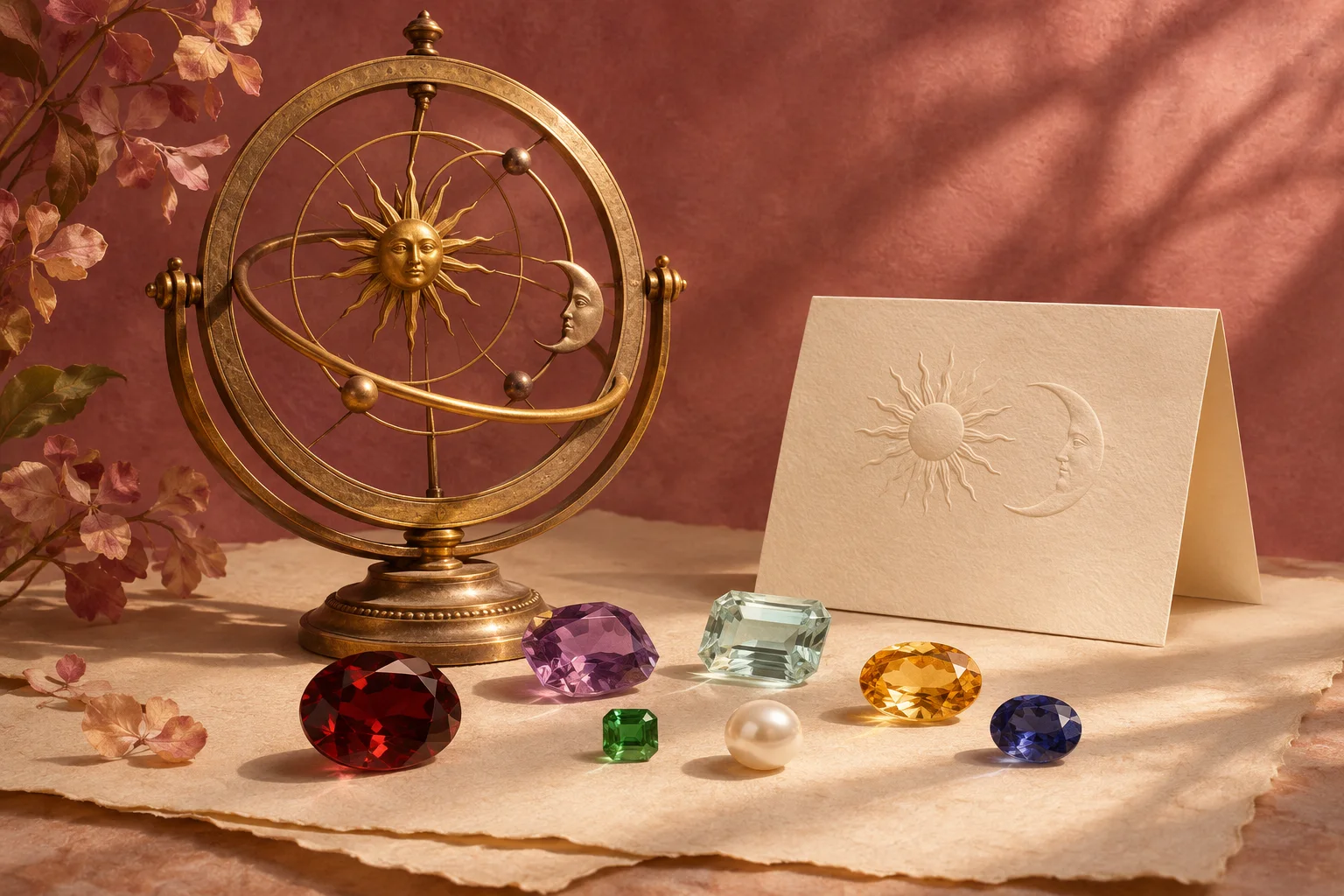
There is no single worldwide compulsory list. These associations reflect cultural and jewelry-industry conventions; they do not imply medical benefits, protection or good fortune. Our gemstone images are AI-created editorial illustrations. They do not establish the identity, grade, treatment or price of any stone.
The Chinese year changes at New Year.
We store the first day of the first lunar month from Hong Kong Observatory’s 1901–2100 Gregorian–lunar conversion tables. The repository includes the import script, source URLs and source hashes. Visitor calculations do not call HKO or an external calendar service.
A birthday earlier than that year’s printed New Year date belongs to the preceding animal year. For example, 9 February 2024 is in the Rabbit year; 10 February 2024 begins the Dragon year. The ten stems and twelve branches determine the repeating sixty-year pairing, including its conventional Wood, Fire, Earth, Metal or Water label.
We compare your entered Gregorian date with the printed HKO civil date. We do not convert an exact overseas birth instant into Chinese standard time. This popular New Year convention is not a BaZi or Eight Characters chart; some systems change their year at Li Chun. Other regional zodiac traditions may have different animals and conventions. Very early 1901 results can identify the preceding animal year without claiming a New Year start date from outside the imported tables.
A Moon snapshot, not a recovered birth moment.
The Moon result is calculated at 12:00 UTC on the entered Gregorian date. We give the reference time alongside a rounded percentage of the disc illuminated. The eight phase names group the elongation into 45° sectors centered on the standard phase directions; they do not identify the exact minute of a quarter or full Moon. A date alone cannot recover the Moon’s appearance at birth.
The tool uses Astronomy Engine’s MoonPhase and Illumination functions locally. The small graphic is a schematic north-up phase illustration, not a telescope image or a local horizon view. For a separate printable Moon keepsake, you can visit Stars After Dusk. Your birthday is not put into that link, and our calculator does not depend on that publication.
Age and milestones count calendar dates.
Age uses completed Gregorian anniversary years as of your device’s local date. Day totals are the difference between civil dates, rather than elapsed 24-hour periods since a known birth instant. Daylight-saving changes do not add or remove a day in this count. The next milestone is the next multiple of 1,000 calendar days after today.
For 29 February birthdays, choose February 28 or March 1 as the anniversary in non-leap years. That choice affects the displayed age, countdown and next birthdays. It is a personal planning convention, not a legal age determination. Leap years follow the Gregorian rule: divisible by four, except century years that are not divisible by 400.
Keep it, share it, or leave it here.
Your date and calculations remain in the page’s memory unless you select “Remember my date on this device.” That optional choice saves only the date in this site’s local browser storage; the clear control removes it. On a shared device, leave that option off. You can use the tool when browser storage is blocked.
The save control creates a PNG locally with the date, sign uncertainty, stones, animal year, Moon reference time, calendar summary and source note. “Share image” opens your device’s share sheet when supported; otherwise it downloads the image for you to attach. Sharing or sending the file is your decision. “Print / PDF” uses your browser’s print dialog; “Copy summary” writes a source-labelled summary to your clipboard.
Birth dates are never added to the page address or submitted to an identity backend. Ordinary requests still deliver site scripts, fonts and illustrations. Optional analytics follows the site’s separate consent settings; this integration sends no calculator inputs or result events.
Primary references
- GIA monthly birthstone guides
- International Gem Society modern and traditional chart
- Hong Kong Observatory Gregorian–lunar conversion tables
- HKO heavenly stems and earthly branches
- V&A: the lunar zodiac in art and cultural history
- Astronomy Engine source, definitions and MIT licence
- US Naval Observatory: phases and percent illuminated
- IAU: astronomical constellations